Good Meat BreakdownGood Meat® Snapshots
Jessica Jager

Written by Good Meat Project
Revised
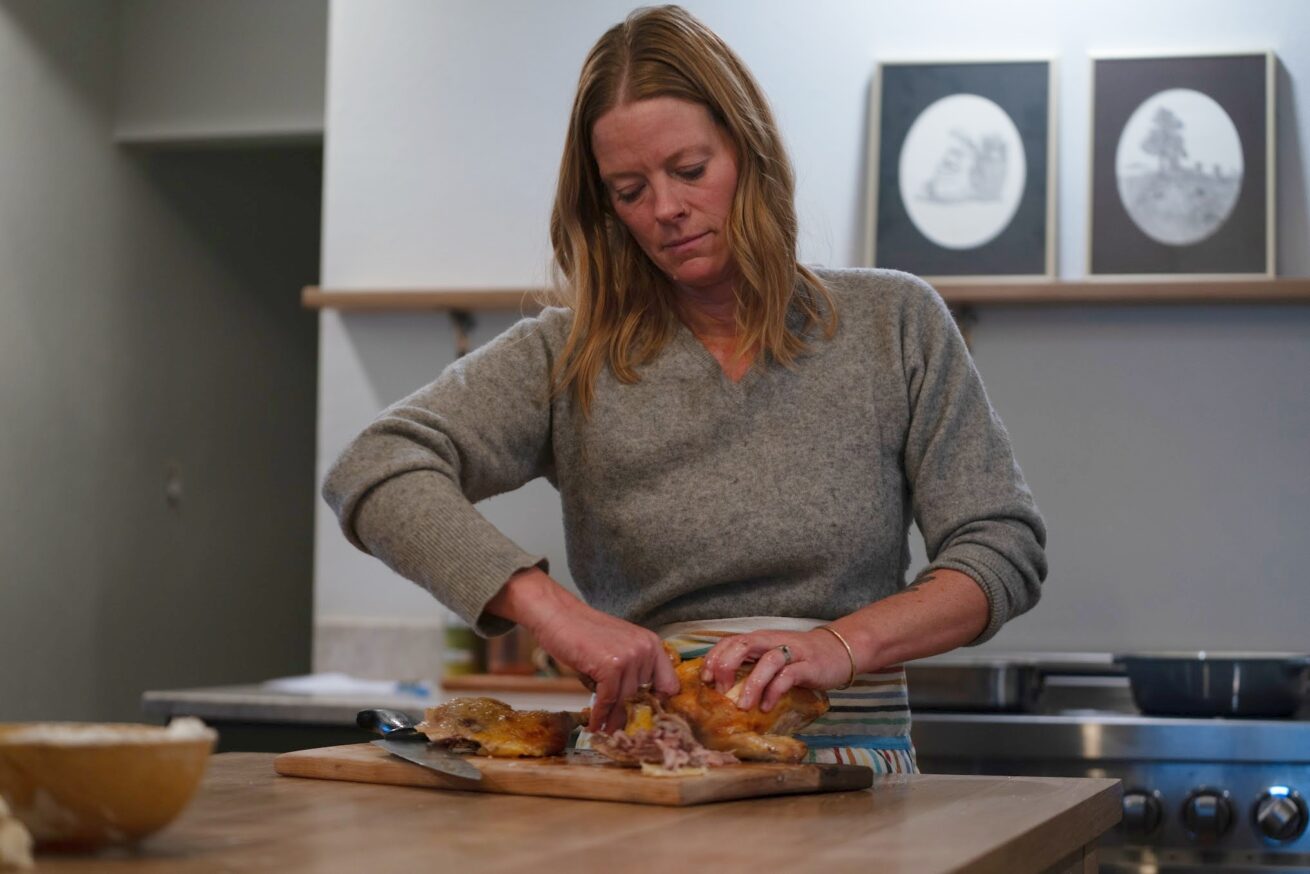
Jessica is the farmer and chef behind Your Friends Farm, a 35-acre regenerative farm outside Spokane, Washington, where she lives with her family. She runs the day-to-day operations with a whole-system approach, raising pork, lamb, and chicken, producing eggs, and growing vegetables for a CSA. With a background as a private chef, Jessica also teaches hands-on cooking classes that make nose-to-tail cooking accessible and help people feel more connected to their food.
What is the name of your farm, and what is your role there?
Your Friends Farm. I’m a full time farmer. I’m our only employee, which means I work a lot. We raise beef, pork, chicken, and lamb and sell direct-to-consumer. We have 35 acres. We do birth-to-butcher on our lamb and our pork, and then we buy in feeders for our steers. And then chicken, of course, we raise out here and we butcher them ourselves here.
So, as much as the harvest that can be done on the farm is done on the farm, not necessarily by us but in the way that it needs to be done. And then some of our beef has to go off farm to be harvested just because of the volume that we’re doing at this point. So, I do all the day-to-day, all of the marketing, office sales, all the customer [service]…everything that’s needed. So it’s a big job.
How long have you all been in operation?
We’re going into our sixth Spring.
You have a background as a private chef. Tell us a little bit about that, and how that led into farming.
I always enjoyed cooking. I grew up with grandmothers that kept me real close by in the kitchen. I never got in trouble and there was never a mess that couldn't be made, so I really grew up with a really strong love of kitchen and cooking. Then as I grew into an adult and I had small kids I realized I really didn't know how to feed them. I was like, I don't know, really, what it means to eat healthy…so when I had these little humans that I'm supposed to be nourishing and growing into full grown adults I was like holy crap what am I supposed to do here?
It was in this season when Joel Salatin was coming on the scene…A friend of mine had bought a little two acre micro farm…and she was like, ‘Let's try to raise our own chicken and pigs,’ and I was like, ‘Heck yeah. Yes, let's do it. Let's do it with our little people in tow. And so our very first time we raised 350 chickens because we figured we could get enough chicken for the year for the pair of us and pay for it and sell the rest. It was insane!
Simultaneous to this happening, I’m doing little cooking things for friends…essentially a party caterer…What was different about what we were doing is: I was sourcing everything I could from within 15 miles of where we served it, and that was a passion for me. Through those seasons, I started to create this really deep community with other farmers, but also fishermen, cheesemongers…
And through that time—going to the fields every morning, or going to the docks every morning, or going to wherever I was sourcing the food—I really became quite enamored. We had grown up in the farming community…but I’d never really seen it on scale before, like on the scale of a consumer situation. And I was like, “I really want to be on this side of the industry. I want to be growing. I want to be tending.”
My husband and I formed a plan that we were going to do this…We had a plan that we were going to pay for this full operation by the time we were fifty (and we’re forty three right now). 2020 hit, and just like everybody, our life got flipped upside down. My husband came upstairs and was like, “...I don’t want to do the spreadsheet. If we’re going to buy a farm, let’s just buy a farm.” And I was like, “Okay!” And we did it.
And that whole time I was cooking in-home for people, and the whole time I was sourcing our own food the same way that I provide food for other families now. So I did that whole in-home thing for 16 years, until we got the farm. And now I dabble in it as much as I can. My husband is still working full-time—he works from the farm, but in his own role—and then I farm full-time. That wasn’t really exactly how we saw it to be, but it’s what we’re doing.
It’s a lot. It’s helpful that…we grew up in a farming community, and I grew up right next to my dad going to other farms, I understood the work that was involved. I wasn’t completely starry-eyed about this dreamy romantic experience. I knew it was going to be work, and I think that’s helped a lot, but also, it has been exactly what I wanted, what I dreamed of.
How has being a chef has influenced you as a farmer, or vice versa?
I think my time cooking in-home for people and doing smaller scale cooking… anywhere from four people to thirty people…you really start to understand how the way things are grown, or the way things are cared for…impact the end result, being the ingredient at hand. And in my time as a chef, I really invested so much of my energy into curiosity and conversation with the community that I had so excitedly collected around me…You start to become quite curious about what impacts the end result. I think that has really informed the way I approach our farming, and the way I approach even how we care for our animals—how we carry ourselves around them, the stress that they endure or don’t endure. That’s all very, very important to me, because through that time I learned the difference even from one lamb to the next, one pig to the next, one cow to the next…Every little thing matters.
What’s one of your biggest challenges as a farmer?
Labor. I work a lot, I work really hard, and it’s nearly impossible to hire someone. And it’s such a complicated challenge. First of all, it’s hard legally to hire someone with proper benefits and insurance and all of that. And that also has a financial piece–to legally hire someone in a way that I can afford is nearly impossible. So that’s one of the largest challenges. We’re really at a point where I can hardly keep up, and so for us to grow anymore feels really daunting right now. So that’s probably one of our biggest challenges.
How would you define your values as a Good Meat® producer?
My values as a meat producer start with the soil, but it’s really based on connection. The way that I raise and grow and care for our animals–the meat on our farm before it’s meat–has to remain part of a whole. If the way I’m doing things is not best for the land, as well as the creature, as well as myself, as well as the community we feed, then it doesn’t work.
And that’s really my ethic. I want to look at the entire connected community. And that involves all four of those things. The minute that I leave myself out of that—the minute I’m like, I can work five more hours this week to grow instead of 10 beef, I can grow 15. The minute that I value the money over the animal itself, or the minute I value the customer and giving them more than they’re paying for, even in convenience, or the minute that I value the dollar over what our land can actually support for the animal, I lose it. It no longer works, because it’s no longer the heart that I started with. It’s no longer honoring. And that would be a problem for me.
What’s your favorite recipe to make?
My very favorite recipe to make is moussaka. It is a very seasonal recipe because you have to wait until the eggplant is ready. Eggplant from the grocery store is not the same as eggplant picked from the garden at its peak ripeness off the vine. About that time you also have fresh tomatoes, and about that time I have a freshened cow, and so I can make all of the things that go into the white sauce. And then I always have held back some ground lamb, because we usually haven’t harvested by then. And that is such a treat to me. It’s like all these different pieces from the farm are just coming together as one and it tastes as it should. It’s the only time of year that I make it and we all anticipate it coming again as we see the eggplants ripening in the garden. And so it really honors everything that we do. I look forward to it.
What’s your go-to meat dish right now?
I’ve actually been working on a special project, and it goes along with chicken. It’s not a go-to, it’s more labor-intensive. I learned how to debone an entire chicken while keeping it whole and making a roulade of sorts. It’s a French preparation and I’ve seen it for years, but I’ve never done it. I’m breaking down all these chickens all the time for our family and I was like, you know what, I'm just gonna start deboning it first. You debone it and then you have it laid out flat–the legs are still whole but the bone is gone. And then I've been stuffing it with apples, sage, and stale bread (so, making the stuffing with it), and then you roll it up, and you tie it. Then I put it on my Traeger. So it takes three hours at 225F, and the skin gets really nice, and it’s just delicious. That's what I've been doing. That’s been my little favorite winter project.
Good Meat® Snapshots
Popular Links
Transparency in meat, from pasture to plate.
Practical tools and a national directory to help you choose—and champion—ethical and responsible meat.